| |
The Brain
ideas to evaluate for implementation
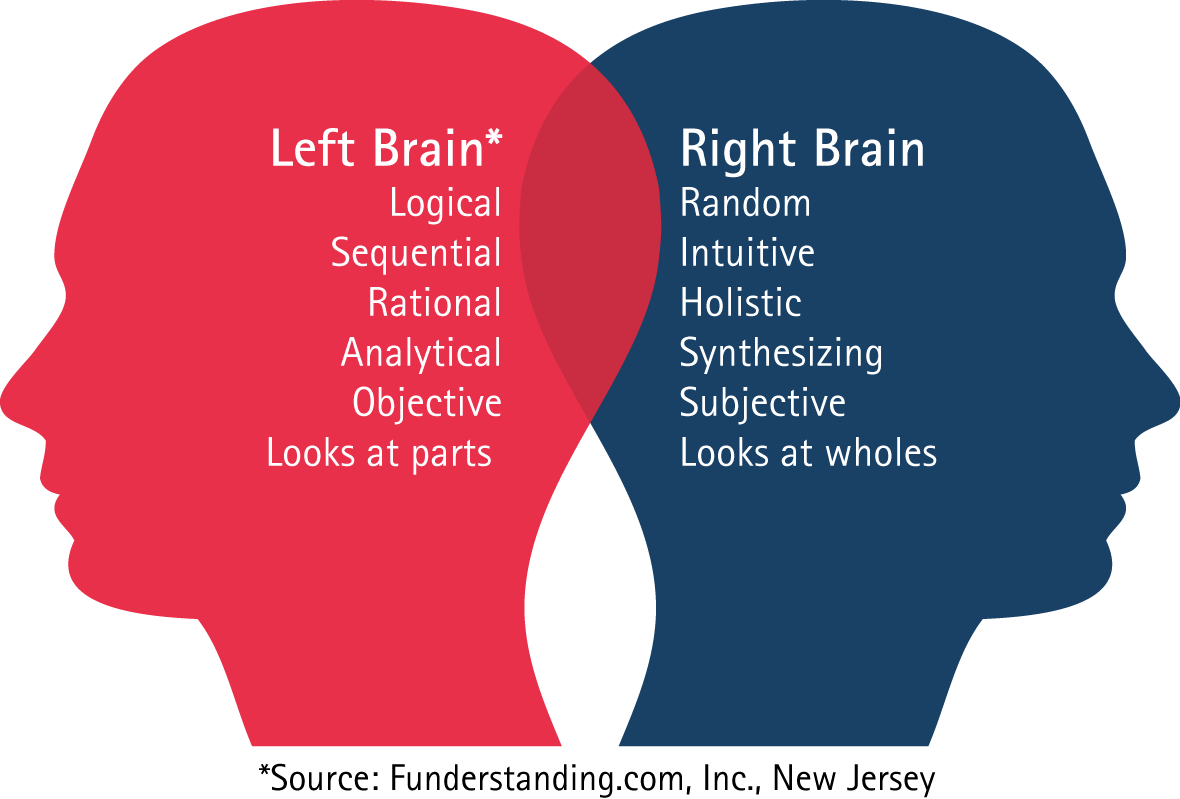
The Brain
Until recently, the abilities that led to success in school, work, and business were characteristic of the left hemisphere. They were the sorts of linear, logical, analytical talents measured by SATs and deployed by CPAs. Today, those capabilities are still necessary. But they're no longer sufficient. In a world upended by outsourcing, deluged with data, and choked with choices, the abilities that matter most are now closer in spirit to the specialties of the right hemisphere - artistry, empathy, seeing the big picture, and pursuing the transcendent.
Beneath the nervous clatter of our half-completed decade stirs a slow but seismic shift. The Information Age we all prepared for is ending. Rising in its place is what I call the Conceptual Age, an era in which mastery of abilities that we've often overlooked and undervalued marks the fault line between who gets ahead and who falls behind.
Last century, machines proved they could replace human muscle. This century, technologies are proving they can outperform human left brains - they can execute sequential, reductive, computational work better, faster, and more accurately than even those with the highest IQs. (Just ask chess grandmaster Garry Kasparov.)
Consider jobs in financial services. Stockbrokers who merely execute transactions are history. Online trading services and market makers do such work far more efficiently. The brokers who survived have morphed from routine order-takers to less easily replicated advisers, who can understand a client's broader financial objectives and even the client's emotions and dreams.
Or take lawyers. Dozens of inexpensive information and advice services are reshaping law practice. At CompleteCase.com, you can get an uncontested divorce for $249, less than a 10th of the cost of a divorce lawyer. Meanwhile, the Web is cracking the information monopoly that has long been the source of many lawyers' high incomes and professional mystique. Go to USlegalforms.com and you can download - for the price of two movie tickets - fill-in-the-blank wills, contracts, and articles of incorporation that used to reside exclusively on lawyers' hard drives. Instead of hiring a lawyer for 10 hours to craft a contract, consumers can fill out the form themselves and hire a lawyer for one hour to look it over. Consequently, legal abilities that can't be digitized - convincing a jury or understanding the subtleties of a negotiation - become more valuable.
Even computer programmers may feel the pinch. "In the old days," legendary computer scientist Vernor Vinge has said, "anybody with even routine skills could get a job as a programmer. That isn't true anymore. The routine functions are increasingly being turned over to machines." The result: As the scut work gets offloaded, engineers will have to master different aptitudes, relying more on creativity than competence.
But let me be clear: The future is not some Manichaean landscape in which individuals are either left-brained and extinct or right-brained and ecstatic - a land in which millionaire yoga instructors drive BMWs and programmers scrub counters at Chick-fil-A. Logical, linear, analytic thinking remains indispensable. But it's no longer enough.
Wired, Daniel H. PinkPage
Here are some ideas from the Pragmatic Programmer's "Pragmatic Thinking and Learning":
########################################
There are two cognitive modes: L-mode and R-mode. L-mode (L for linear) gives you these abilities:
• Verbal: using words to name, describe define
• Analytic: figuring things out step-by-step and part-by-part
• Symbolic: using a symbol to stand for something
• Abstract: taking out a small bit of information and using it to represent the whole thing
• Temporal: keeping track of time and sequencing one thing after another
• Rational: drawing conclusions based on reason and facts
• Digital: using numbers as in counting
• Logical: drawing conclusions based on logic (theorems, well stated arguments)
• Linear: thinking in terms of linked ideas, one though directly following another, often leading to a convergent conclusion
R-mode (R for rich) gives you these abilities:
• Non-verbal
• Synthetic
• Concrete
• Analogic
• Non-rational
• Spatial
• Intuitive
• Holistic
We have a bit of a cultural bias toward L-mode thinking and related activities.
Although the analytical and verbal capabilities of L-mode thinking have brought us (humanity) this far, we've lost some key capabilities from an overreliance on L-mode at the expense of R-mode. To progress in order to move on to the next revolution in human development, we need to learn to reintegrate our largely neglected R-mode processing with L-mode.
Both L-mode and R-mode have their separate approaches to pattern matching. R-mode sees the forest; L-mode sees the trees. E.g. in the following diagram, L-mode sees lots of instances of the letter 'I', whereas the R-mode sees a big instance of the letter 'H'.
I I
I I
I I
I I
IIIIIIIII
I I
I I
I I
I I
The L-mode is a symbolic machine; it rushes in quickly to provide a symbolic representation for some sensory input. That's great for symbolic activities such as reading and writing but is not appropriate for other activities.
########################################
|
|




)
)
)
)
)
